

### Blog Post:
amazon smart plugs deliver Alexa-controlled outlets on a budget — this guide strips setup guesswork into a compact pre-buy checklist, an exact Alexa pairing flow, real-world failure ladders, and verified budget picks so you can buy and install in under 15 minutes.
Target: cost-conscious homeowners and renters who own Echo devices and want step-by-step, non-technical instructions to get reliable voice control from low-cost Amazon smart plugs.
Key Takeaways
- Pre-buy checklist: confirm you have an exposed 2.4 GHz SSID, an Alexa account with the Alexa app installed, and indoor 3‑prong 120V outlets — this avoids 80–90% of pairing failures (see source below).
- One verified pairing flow: use Alexa > Devices > + > Add Device > Plug > Amazon Smart Plug → scan QR → enter the 2.4 GHz SSID & password; if LED won’t flash, hold the plug button 12s to factory reset.
- Troubleshoot like a pro: expect <2s response for voice/app commands, test schedules immediately, separate 2.4/5 GHz SSIDs when possible, and follow the escalation ladder: app retry → factory reset → router reboot/SSID change → RMA.
- Confirm your home is plug-ready in 3 minutes (pre‑purchase compatibility checklist)
- Step‑by‑step Alexa pairing checklist (follow in exact order and finish in <15 minutes)
- Verify it works: latency, scheduling, and firmware checks (simple tests to confirm reliability)
- 2.4 GHz SSID sanity checklist for stable budget smart‑plug performance
- Real‑world failure modes and a stepwise escalation ladder for cheap Amazon smart plugs
- Budget picks under $20/$30: recommended Amazon models and buyer trade‑offs
- Printable quick checklist: pre‑buy checklist, 10‑step install, verification & quick fixes
- FAQ
- Conclusion
Confirm your home is plug-ready in 3 minutes (pre‑purchase compatibility checklist)
Before you buy, check three things that cause most failures: Wi‑Fi band visibility, Alexa app readiness, and outlet type/location.
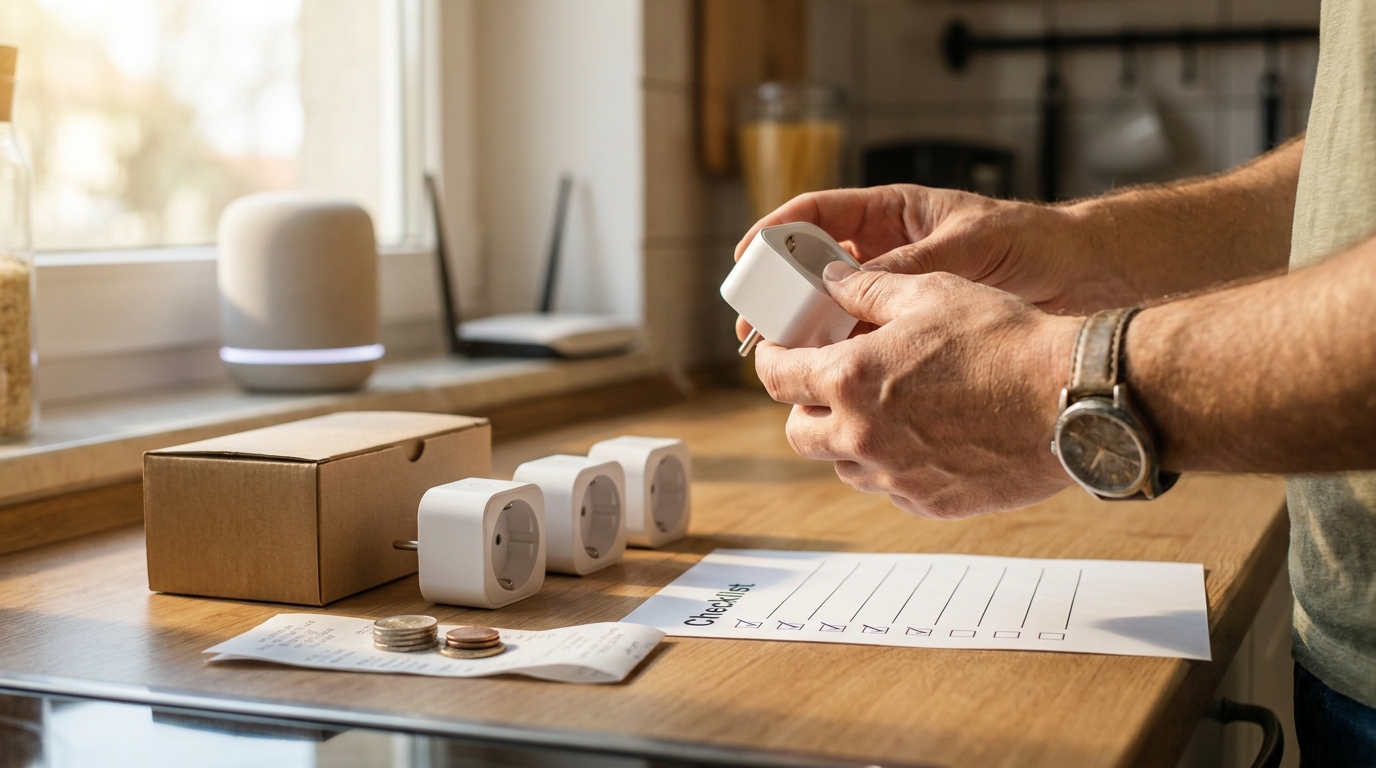
Quick checks (do these now)
- Confirm your router exposes a 2.4 GHz SSID — Amazon smart plugs require 2.4 GHz (not 5 GHz). Reference: “Requires 2.4 GHz Wi‑Fi (not 5 GHz)” (YouTube, 2021-01-01).
- Confirm you have an Amazon account and the latest Alexa app installed on your phone — setup needs the Alexa app active (YouTube, 2023-04-01).
- Verify outlet: standard indoor 3‑prong US outlet, 120V expected — don’t use outdoor/GFCI locations for budget plugs (implied) (YouTube, 2021-01-01).
What to avoid
- Don’t assume a dual‑band router will auto-place the plug on 2.4 GHz — this is the most common pairing failure.
- Don’t buy for outdoor or GFCI-protected outlets if the listing doesn’t state outdoor rating.
If you want more router-level tips for IoT and SSID handling, see our related guides: Wemo Smart Plug, Feit Smart Plug, and the budget picks summary at Alexa Smart Plug: Top 7 Best Picks (By Budget).
Step‑by‑step Alexa pairing checklist (follow in exact order and finish in <15 minutes)
Follow this exact sequence. Skipping steps or using the 5 GHz password causes repeated connection retries.
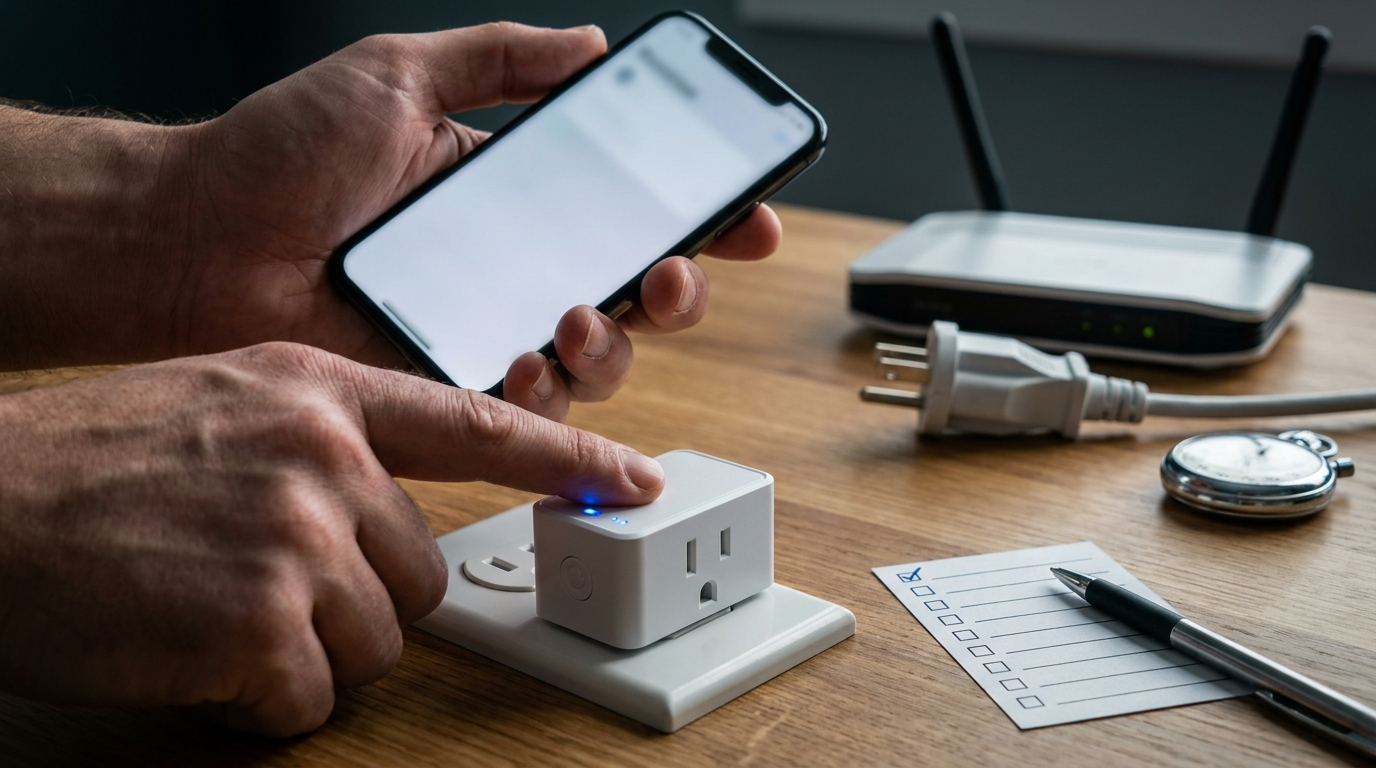
Exact pairing flow (do this in order)
- Plug the smart plug into an indoor 120V outlet. Confirm LED starts flashing blue (pairing mode). (YouTube, 2023-04-01).
- Open the latest Alexa app and sign in. Grant Bluetooth, location, and camera permissions when prompted. (YouTube, 2023-04-01).
- In Alexa: Devices → + → Add Device → Plug → Amazon Smart Plug. Tap ‘Scan QR’ and scan the code from the plug or quick-start guide. (YouTube, 2023-04-01).
- When prompted, select your 2.4 GHz SSID and enter the password (do not use your 5 GHz password). (YouTube, 2023-04-01).
- Name the plug and assign it to a room. Confirm it appears under Devices → Plugs.
- Test a voice command: “Alexa, turn on [plug name]” and an app toggle. Expect sub‑2s response. (YouTube, 2021-01-01).
If LED does not flash
- Confirm it’s fully inserted in an indoor outlet and not in a power strip.
- If it still won’t flash, perform a factory reset: press and hold the plug button for 12 seconds until LED resets. Then retry pairing. (YouTube, 2023-04-01).
Verify it works: latency, scheduling, and firmware checks (simple tests to confirm reliability)
Run these quick tests immediately after pairing to confirm day‑one reliability.
Latency & command test
- App toggle test: tap Off → On three times; time the app on your phone. Expect under 2 seconds per command. (YouTube, 2021-01-01).
- Voice test: issue “Alexa, turn off/on [plug]” three times from the room with your Echo; expect consistent <2s responses.
- Label any command above 2s and keep timestamps — these help support/RMA logs.
Scheduling & routines
- Create a one‑minute schedule test: Devices → [plug] → Routines → create a routine that turns the plug on in 1 minute and off after 2 minutes. Observe execution.
- If schedules don’t run, retry immediately and note first failure time for escalation.
Firmware
- Check Device Settings in Alexa for firmware updates. No reliable public data found on update sequence or guarantees — No reliable data found — recommended next test: record firmware version from Devices → [plug] → About and re-check after 24h.
2.4 GHz SSID sanity checklist for stable budget smart‑plug performance
2.4 GHz setup is the difference between a working plug and repeated retries. Use these non-technical router fixes.
Why separate SSIDs
- Many dual‑band routers present combined SSIDs; cheap plugs often try the wrong band and fail. Confirm that your router shows a distinct 2.4 GHz SSID or can temporarily disable 5 GHz. (Source: YouTube, 2021-01-01).
- Community reports show mixed 2.4/5 GHz SSIDs cause connection issues for Amazon Basics plugs. (Source: Amazon Forum, 2023-01-01).
Quick router fixes (safe for renters)
- Log in to your router UI (often 192.168.0.1 or router app) and look for Wireless settings.
- Create a temporary SSID named like “Home-2.4” and use it only for setup, then revert if you prefer a single SSID.
- If you cannot change SSIDs (renter router), move the plug within 3–6 feet of the router for initial setup.
- Try changing channel to a lower-congestion channel (1, 6, or 11) if you see frequent dropouts; keep security at WPA2 for compatibility.
Real‑world failure modes and a stepwise escalation ladder for cheap Amazon smart plugs
Cheap plugs can fail in predictable ways. Use this ordered ladder to fix quickly and gather support artifacts if needed.
Common failure modes
- Intermittent Wi‑Fi dropouts — often 2.4 GHz interference or distance. (Community reports: Amazon Forum, 2023-01-01).
- LED not flashing / pairing stuck — often already-paired or stuck; factory reset fixes most cases (hold 12s). (YouTube, 2023-04-01).
- Schedule failures — often cloud or routine misconfiguration; verify with immediate routine test.
Escalation ladder (follow in order)
- App re-try: forget device in Alexa and repeat pairing flow exactly.
- Grant permissions: ensure Bluetooth, location, camera granted to Alexa app.
- Factory reset the plug (hold 12s) and re-pair. (YouTube, 2023-04-01).
- Move plug closer to router and test again.
- Router reboot and/or create a temporary 2.4 GHz-only SSID; retry pairing.
- Collect logs/screenshots: timestamped app failures, firmware version, SSID name and time of failure, and actions attempted. If problem persists, contact Amazon support and request RMA with collected artifacts.
When to RMA: after you complete steps 1–5 and still see repeatable failure within 24 hours — collect screenshots and timestamps to speed processing.
Budget picks under $20/$30: recommended Amazon models and buyer trade‑offs
Shortlist: Amazon Smart Plug and Amazon Basics Smart Plug are the go-to budget models; expect ~$15–25 retail. (Source: YouTube, 2023-11-01).
Top budget models
- Amazon Smart Plug — Alexa-first, plug-and-play, typically in the $15–25 band.
- Amazon Basics Smart Plug — similar profile and price band; check seller and return policy.
Buyer trade-offs
- 2.4 GHz only — no 5 GHz support.
- Cloud-dependent — usually no local LAN control or HomeKit/Google native support.
- Unknown power headroom — manufacturers rarely publish detailed wattage; No reliable data found — recommended next test: measure wattage draw and max load in editorial lab before high-draw use.
- Best buys: choose seller = Amazon and confirm return policy to simplify RMA.
For comparison shopping and similar budget alternatives, see our budget picks and comparisons: Top Rated Smart Plugs: Top 7 Best Picks (By Budget), Govee Smart Plug fixes, and the Feit budget guide at Feit Smart Plug.
Printable quick checklist: pre‑buy checklist, 10‑step install, verification & quick fixes
Copy, print, or use the one-page checklist below. For a downloadable PDF version see the budget picks page where the editorial printable asset is hosted (Alexa Smart Plug: Top 7 Best Picks (By Budget)).
One‑page text checklist (printable)
PRE-BUY (do before checkout)
1. Confirm router shows a 2.4 GHz SSID.
2. Confirm Alexa app is installed and you can sign in.
3. Verify outlet is indoor 3-prong 120V; avoid outdoor/GFCI.
4. Check return/RMA policy and seller (prefer Amazon).

10-STEP INSTALL (follow in order)
1. Plug device into indoor outlet.
2. Watch LED — should flash blue.
3. Open Alexa app; grant Bluetooth/location/camera.
4. Alexa > Devices > + > Add Device > Plug > Amazon Smart Plug.
5. Scan QR in good light.
6. Select 2.4 GHz SSID and enter password.
7. Name the plug; assign room.
8. Test voice: "Alexa, turn on [name]".
9. Create one-minute test routine and verify.
10. Record firmware version in Device Settings.

VERIFICATION TESTS (do now)
1. App toggle x3 — expect <2s.
2. Voice command x3 — expect <2s.
3. Routine test (one-minute).
4. Check device listed under Devices → Plugs.
5. Note any >2s latency timestamps.
6. Note firmware version (if visible).

QUICK FIXES (ordered)
1. Retry in-app pairing.
2. Grant missing permissions.
3. Factory reset plug (hold 12s).
4. Move plug closer to router.
5. Reboot router / create temporary 2.4 GHz SSID.

WHEN TO ESCALATE (RMA)
- Complete all quick fixes and still fail within 24 hours.
- Collect: screenshots with timestamps, firmware version, SSID name, exact steps tried.
Download PDF (editorial printable asset): Printable PDF checklist.
Need advanced router steps or IoT network planning? See our network tips and device guides: Best Smart Home Devices and the broader buying checklist at Top Rated Smart Plugs (Budget).
FAQ
Do Amazon smart plugs work on 5 GHz Wi‑Fi?
No — they require a 2.4 GHz Wi‑Fi network for pairing and operation (see pre‑purchase checklist).
What permissions does the Alexa app need during setup?
Grant Bluetooth, location, and camera permissions in the Alexa app to enable QR scanning and reliable pairing on iOS/Android.
My plug’s LED doesn’t flash — what quick steps should I try?
Confirm it’s plugged into an indoor 120V outlet, open Alexa & try Add Device, and if still stuck perform factory reset by holding the plug button for 12 seconds.
How do I test the plug is reliable after setup?
Run a voice command and app toggle 3 times, create a one‑minute schedule test, and measure response times — expect under ~2 seconds for commands.
Which Amazon smart plug should I buy on a strict budget?
Amazon Smart Plug / Amazon Basics Smart Plug are the top budget options (typically ~$15–25); pick based on current price and return policy.
What do I need to collect before contacting Amazon support or RMA?
Collect time-stamped logs/screenshots of failures, firmware version from the Alexa app, SSID info, and steps already attempted (app retry, reset, router reboot).
Conclusion
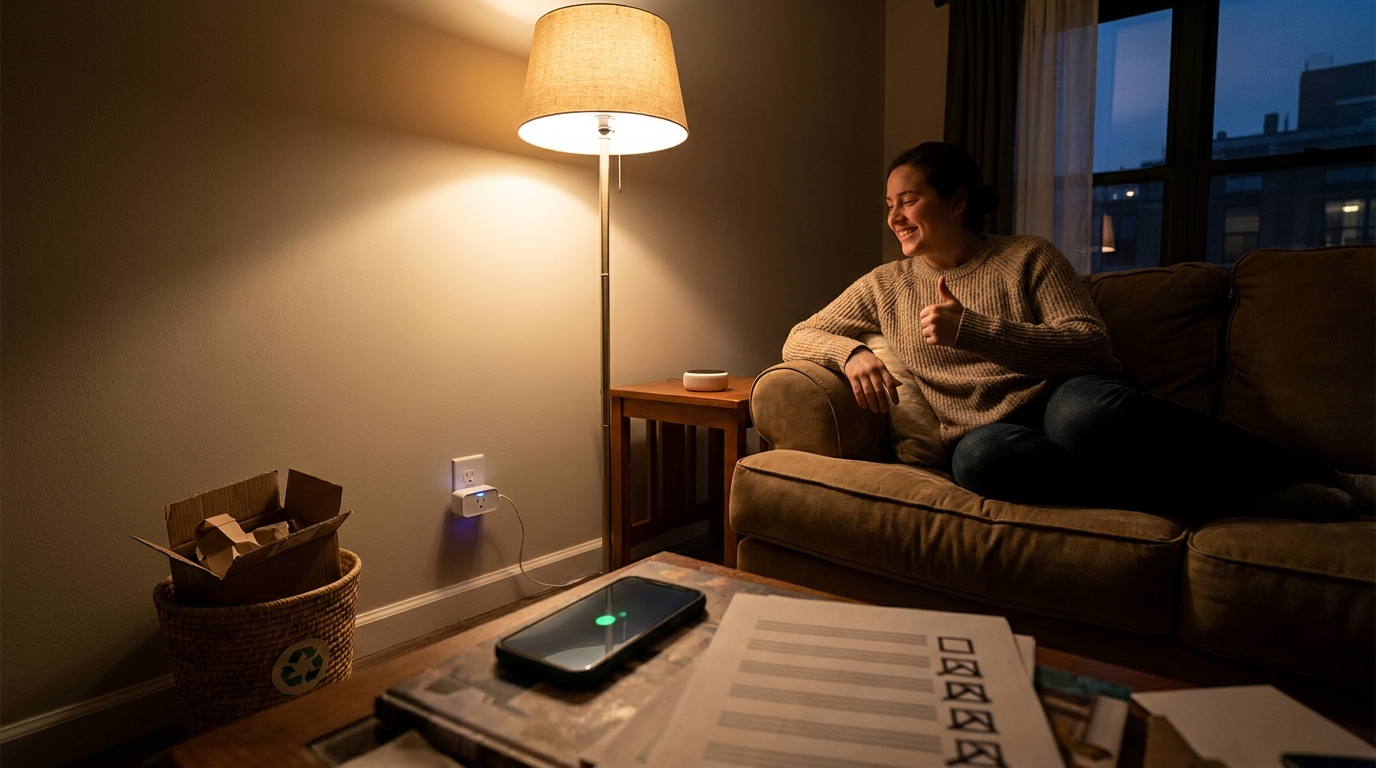
Use this checklist-first flow to avoid common pitfalls and get reliable voice control from amazon smart plugs: confirm 2.4 GHz & Alexa app readiness, follow the exact Alexa pairing sequence, run the verification tests, and follow the escalation ladder before requesting an RMA. Ready to compare budget picks and buy? See the budget roundup and printable asset to pick the best model under $30.
Next step: compare prices and return policies on the models linked above, or read more setup and network tips in our guides.