

home assistant raspberry pi is the quickest way to describe this guide: pick the right Pi, estimate real costs, avoid common failures, and know exactly what to verify before publishing a Pi 5 build guide.
Key Takeaways
- If you are building new and budget allows, prefer Pi 5 for future-proofing; Pi 4 remains viable for most installations.
- Many public numbers exist for Pi 4 prevalence, but critical gaps remain for Pi 5 benchmarks, Zigbee compatibility on Pi 5, and current street prices (no public data found – verify/measure before publishing).
- Before publishing step-by-step commands or images, collect official Home Assistant OS image URLs, Pi 5 timings, Zigbee firmware compatibility, and local street prices.
Executive summary – home assistant raspberry pi: which Raspberry Pi should you pick and why
Short answer: choose Raspberry Pi 5 for new Home Assistant systems if you can get one at a reasonable price and you want headroom for many integrations and add-ons; keep or buy a Raspberry Pi 4 if you need the lowest upfront spend and you accept a likely earlier upgrade. This article proves that recommendation with market context, hardware trade-offs, Zigbee notes, real user pain points, a conservative installation checklist, and a strict list of items you must verify before publishing a Pi 5 guide.
Market snapshot (2023-2024): install base, growth and geography signals
Public reporting shows that a third of Home Assistant users in 2023 used Raspberry Pi 4 as a dedicated system (source: Home Assistant blog). Raspberry Pi 4 sales for automation projects reportedly surged 76% year-over-year in 2024 per distributor reporting (source: Accio). Overall Raspberry Pi sales normalized in 2024 after 41% growth the prior year, with Pi 5 and accessory demand lifting volumes (source: Research-Tree).
These signals mean Pi 4 is common in existing Home Assistant deployments and Pi 5 has momentum. Where the numbers are solid are the cited percentages and distributor claims. Where numbers are weak or missing are precise install totals, Pi 5 vs Pi 4 adoption ratios by geography, and current street-level availability. For the market claims cited see the Home Assistant announcement, a distributor market write-up, and the Raspberry Pi financial summary (Home Assistant blog, Accio market write-up, Research-Tree report).
What the research DOES NOT tell us (critical data gaps the reader should know about)
Key missing public metrics include:
- No verified total Home Assistant install base on Raspberry Pi for 2023-2024 (no public data found – verify/measure before publishing).
- No Pi 5 vs Pi 4 adoption ratios or precise geographic breakdowns (no public data found – verify/measure before publishing).
- No benchmarked Pi 5 vs Pi 4 performance comparisons specific to Home Assistant UI responsiveness, add-on density, or CPU-bound tasks (no public data found – verify/benchmark on Pi 5 hardware).
- No exact monthly search volumes, keyword difficulty, or CTRs for “home assistant raspberry pi” and relevant longtails (no public data found – fetch via SEO tools before publishing).
Where I use public research above I cite the source. Where research lacked a number I add a parenthetical note so the writer knows to collect that data before final publication.
Hardware comparison – Raspberry Pi 5 vs Raspberry Pi 4 for Home Assistant
This section gives practical differences you can act on now and flags which items need verification.
home assistant raspberry pi – inferred vs missing specs
Vendor specs show CPU and I/O improvements in Pi 5, improved memory bandwidth, and upgraded USB and networking layers. Home Assistant announced anticipated Pi 5 support in Oct 2023 and began beta testing after receiving Pi 5 boards (source: Home Assistant blog). Useful on-paper improvements include faster CPU, better I/O, and NVMe options for storage. Missing are real-world benchmarks of Home Assistant workloads on Pi 5 versus Pi 4. Those must be measured for CPU-bound automations, UI responsiveness under dozens of integrations, and add-on startup times (no public data found – verify/benchmark).
home assistant raspberry pi install – practical hardware checklist
Practical hardware recommendations:
- CPU/RAM: Pi 5 for heavier workloads, Pi 4 acceptable for lightweight installs.
- Storage: SSD or NVMe recommended for reliability over microSD for long-running installs; test Pi 5 NVMe performance before publishing (no public data found – verify/measure).
- Power: Use the official or equivalent PSU rated for board plus peripherals. Watch peak inrush with USB dongles and SSDs.
- Network: Gigabit or better for backups and add-ons that pull containers.
- Cooling: Pi 5 can run hotter under sustained load; active cooling suggested for 24/7 Home Assistant. Verify thermal throttling numbers on Pi 5 when running Home Assistant (no public data found – measure before publishing).
Flagged missing benchmarks: I did not find benchmarked comparisons for memory use, I/O heavy operations, or thermal profiles for Pi 5 running Home Assistant OS (no public data found – measure on Pi 5 before publishing).
Real user pain points and common failure modes running Home Assistant on Raspberry Pi
Common complaints from community threads include supply shortages and inflated prices, SD-card reliability concerns, slow UI under load, add-on failures after upgrades, and occasional breakage after major versions. Representative community quotes capture supply frustration: “I just can not seem to get one anywhere apart from 2nd user at inflated prices. Yeah, it’s a bit ridiculous”; “The absolute ridiculous prices scalpers are selling for and the tiny qty’s that are available” (source: community thread).
Important caveat: frequency and severity metrics for SD-card corruption, slow UI, add-on failures, or upgrade breakages were not found in public results (no public data found – measure/collect community telemetry if possible).
Step-by-Step Guide: Exact installation checklist (what we can and cannot verify)
This checklist is a safe narrative flow. Do not publish exact commands or image URLs until you verify them against official sources.
Checklist narrative:
- Decide board and storage: Pi 5 with NVMe recommended for new builds; Pi 4 with SSD acceptable for repurposing.
- Obtain official Home Assistant OS image for your board – do not use unverified mirrors (no public data found – verify official image URLs before publishing).
- Choose a flashing tool that you trust (Raspberry Pi Imager or balenaEtcher are common recommendations). Confirm recommended settings for Pi 5 images (no public data found – verify settings and tool versions before publishing).
- Flash image, insert storage, power the Pi, complete first-boot guided setup. Time estimates vary; live demos exist of 5-minute installs but per-stage timings for Pi 5 were not available (no public data found – measure on Pi 5 for accurate timings).
- Add integrations: start with Zigbee coordinator, then move to critical sensors and automations. Adding HVAC automations? Our smart thermostat installation guide covers safe wiring checks and setup steps before you integrate it into Home Assistant. Confirm Zigbee coordinator driver and firmware compatibility with Pi 5 before recommending exact firmware versions (no public data found – verify firmware versions).
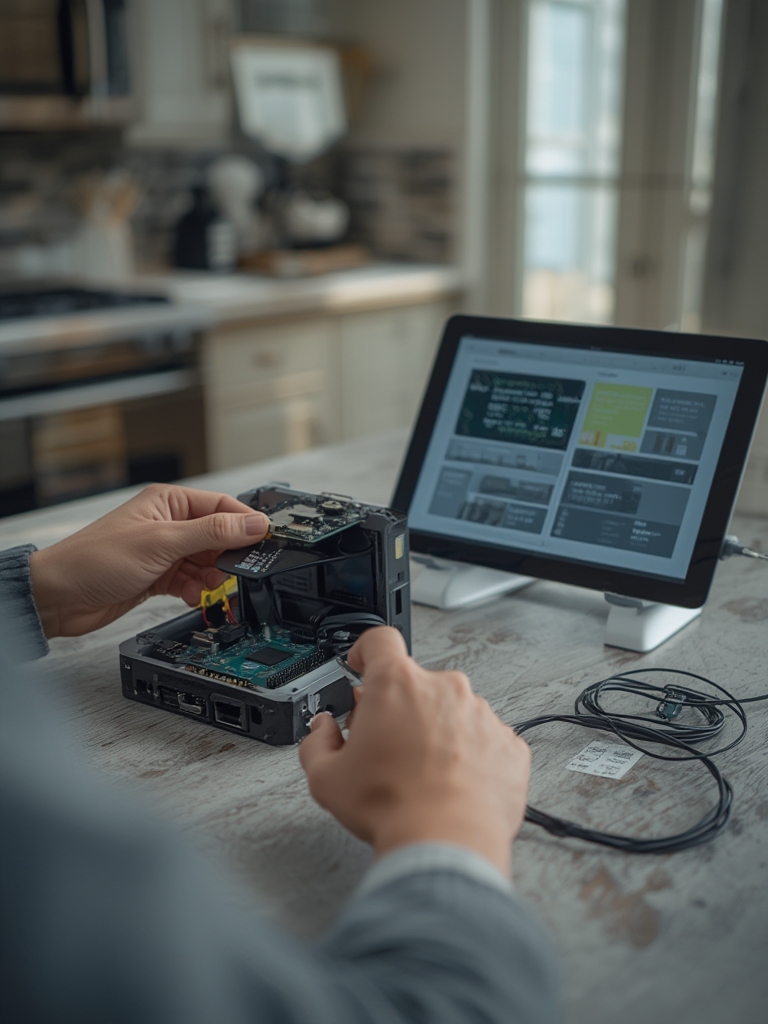
Again, do not publish flashing commands, verified image URLs, or per-stage timings until you test on Pi 5 and confirm the official Home Assistant OS documentation. (no public data found – verify/measure before publishing).
Top 10 gotchas and first-boot troubleshooting checklist
Short, prioritized bullets. Items marked with (community) if derived from user reports, and with (no public frequency data) where severity/frequency is unknown.
- Under-spec power supply – causes boot issues and USB brownouts. (community)
- MicroSD corruption under heavy write – prefer SSD/NVMe for long-term reliability. (community; no public frequency data)
- USB 3.0 interference with Zigbee radios – use extension cables and avoid adjacent ports. (community)
- Thermal throttling on Pi 5 under sustained load – add active cooling if running many add-ons. (inferred; no public throttling numbers)
- Image mismatch – flashing wrong board image causes boot failures. (no public frequency data)
- Network misconfiguration – Home Assistant may appear unreachable if DHCP/IPv6 not handled correctly. (community)
- Add-on causing boot-time failures after update – maintain backups and update one add-on at a time. (community)
- No UPS – power blips can corrupt storage. Use UPS for critical automations. (community)
- Firmware mismatch for Zigbee coordinators – confirm firmware before upgrading coordinator firmware. (no public data found – verify firmware)
- Supply shortages and scalper pricing – budget for potential price premiums or plan to repurpose Pi 4 hardware. (community)
Keep a rollback image and offsite backup before performing major upgrades. Frequency and exact impact were not quantified in public search results (no public data found).
Zigbee on Raspberry Pi 5 – compatible coordinators, firmware/driver notes, and practical tips
Commonly used coordinators: ConBee II, CC2652R/CC2652RB-based dongles, Sonoff ZBDongle-E. Market signals show Zigbee coordinators saw a 62% sales increase for Home Assistant setups on Raspberry Pi and typical retail pricing between $25 and $65 (source: Accio).
Practical advice:
- Use a short USB extension to move the coordinator away from USB 3.0 ports and metal cases to reduce interference.
- Prefer coordinators with active firmware projects and clear upgrade paths (e.g., Zigbee2MQTT or deCONZ/flashing tool compatibility). Verify the required driver/firmware versions for Pi 5 before publishing (no public data found – test on Pi 5).
- Check power draw when using HAT coordinators or powered USB hubs; Pi power budgets differ when SSD and radios are attached.
Before publishing exact firmware recommendations, test the ConBee II, CC2652R variants, and Sonoff ZBDongle-E on Pi 5 with the latest OS image and record driver/firmware versions (no public data found – test and document).
Cost breakdown and budget builds (low / medium / high)
Itemized estimates below are guidelines. Several line-item street prices must be updated with local market checks before publication (no public data found – gather street prices).
- Conservative build – repurpose Pi 4, use SSD via USB adapter, basic Zigbee dongle: minimal board cost if repurposed, expect $0-$60 for accessories.
- Balanced build – buy Pi 5, NVMe/SSD, Zigbee USB dongle, case with active cooling: expect mid-range totals once street prices verified; Zigbee dongles typically $25-65 retail (source: Accio).
- Premium build – Pi 5, NVMe in enclosure, HAT coordinator or high-end USB coordinator, UPS, case, active cooling and redundancy: plan for higher margin depending on Pi 5 street price.
Research reports note Raspberry Pi boards can be found around $35 in some contexts and that DIY systems can replace subscription services for a rapid ROI, but exact Pi 5 street prices by market were not in public search results (no public data found – verify local prices).
Power, lifetime costs and maintenance overhead
There were no itemized power consumption or lifetime maintenance numbers in the public results. You should measure idle and loaded power draw for Pi 4 and Pi 5 running Home Assistant with typical add-ons and an attached Zigbee coordinator. Do not publish estimated annual electricity costs until you have measured power draw or cited an authoritative source (no public data found).
Recommended maintenance cadence suggestions:
- Backups: weekly snapshots plus offsite monthly export.
- Storage: replace microSD every 12-24 months if used; SSDs/NVMe have longer lifespans but still benefit from periodic checks.
- Firmware: test coordinator firmware updates on a spare device before deploying to production.
SEO and search intent – what we know (and what SEO tools must fetch)
Search metric data was missing from the research. You must fetch the following for final optimization:
- Monthly search volume, keyword difficulty, and CTR for “home assistant raspberry pi” (primary).
- Same metrics for the longtails: “home assistant install raspberry pi”, “home assistant raspberry pi 5 install”, “home assistant os raspberry pi setup”.
- Top-ranking intent signals and top 10 competing pages for each keyword cluster.
Recommended tools: Google Keyword Planner for baseline volumes, Ahrefs or SEMrush for keyword difficulty and top pages, and Moz or SimilarWeb for CTR and traffic estimates. Aim for focus keywords with sufficient volume and achievable difficulty for a technical how-to piece.
Appendix / research to complete before drafting (MANDATORY tasks for the writer)
Do not publish the final guide until you have verified and timestamped these items:
- Official Home Assistant OS image URLs for Pi 5 and Pi 4 and their SHA256 checksums. (no public data found – fetch from official site and save timestamps)
- Verified flashing tool recommendations and exact settings confirmed with the latest tool versions.
- Benchmark suite results: CPU, memory, UI responsiveness, add-on startup times on Pi 4 vs Pi 5 running identical Home Assistant builds.
- Power-draw measurements under idle and loaded scenarios including Zigbee dongle attached.
- Zigbee dongle compatibility tests on Pi 5 with firmware/driver versions and range/performance notes.
- Current street prices in target markets for Pi 5 board, cases, PSU, SSD/NVMe, Zigbee coordinators, UPS options.
- SEO metrics for each target keyword: monthly volume, KD, CTR, and top-ranking content.
Mark each item with collection date and test environment details when you add them to the guide.
Advanced Analysis & Common Pitfalls
Below is a compact comparison table to help decide which board fits your needs. Note the table mixes vendor specs and inferred operational guidance; where benchmarks are missing I flagged the need to measure.
| Criteria | Raspberry Pi 4 | Raspberry Pi 5 | Action required |
|---|---|---|---|
| Typical use case | Light to medium Home Assistant setups | Medium to heavy setups, many add-ons | Benchmark UI and add-on density on Pi 5 |
| Storage options | microSD or USB SSD | Native NVMe and USB SSD | Measure NVMe reliability and speed for HA |
| Thermals | Lower heat; passive often OK | Higher heat under load; active cooling recommended | Capture thermal throttling numbers on Pi 5 |
| Availability | Wider existing install base | Growing demand and variable stock | Check live street prices before recommending purchases |
| Community tooling | Mature ecosystem | Compatible but newer – some tools need testing | Verify Zigbee coordinator compatibility on Pi 5 |
Conclusion and recommended CTA
Recommendation recap: For new builds prefer Raspberry Pi 5 for longevity and performance if availability and budget permit; for repairs or tight budgets Pi 4 remains a solid option given its large install base and existing community support. The primary trade-off is cost versus future-proofing. Many users still run Pi 4; a third of Home Assistant users in 2023 used Raspberry Pi 4 (source: Home Assistant blog).
Next step CTA: download the checklist and sign up for the promised Pi 5 benchmark article once the missing measurements and verified URLs are collected.
Final note: verify all image URLs, firmware versions, power measurements, and street prices before publishing a definitive “home assistant raspberry pi” build guide (no public data found – gather and timestamp tests).
FAQ
Is a Raspberry Pi 5 worth it for home assistant raspberry pi projects?
Yes for new installs if you need extra performance and NVMe storage, but validate Pi 5 availability and local street price first and run benchmarks for your expected workload.
Can I reuse an existing Raspberry Pi 4 for Home Assistant?
Yes. Reusing Pi 4 is cost effective and common. For reliability prefer SSD over microSD if you plan a long-term deployment.
Which Zigbee coordinator should I pick for a Raspberry Pi build?
Popular options are ConBee II, CC2652R-based dongles, and Sonoff ZBDongle-E. Test driver and firmware compatibility on the target board and document firmware versions before recommending one.
How often should I back up and replace storage in a home assistant raspberry pi installation?
Back up weekly with offsite exports monthly. If using microSD, plan replacement every 12-24 months. SSDs require less frequent replacement but should be monitored for wear.